.png)


Content
How AI is changing B2B content marketing beyond "just use ChatGPT"
February 2, 2026

Master BOFU content B2B strategies for SaaS. Learn why bottom-of-funnel assets drive revenue, see real examples of comparison pages, and fix your pricing page.

In the real world of B2B SaaS, specifically for Series A to C companies scaling past the $10M ARR mark, the journey is a chaotic scramble. It looks less like a funnel and more like a plate of spaghetti. Prospects loop back, stakeholders argue, budgets freeze, and your buyer might read a bottom-of-funnel comparison guide before they even know your brand name.
However, just because the buyer's journey is messy doesn't mean your content strategy should be. Understanding the distinction between stages - specifically effectively deploying bofu content b2b assets - is the difference between a blog that gets traffic and a marketing engine that prints revenue.
We are going to dismantle the traditional content framework, look at why the bottom of the funnel is where the war is won, and provide specific, high-fidelity examples you can steal for your editorial calendar. If you are tired of vanity metrics and want to drive closed-won deals, this is for you.
Before we start writing, we need to look at the math. The effort required to close a deal in 2026 has skyrocketed. We aren't just battling competitors; we are battling noise, indecision, and "touchpoint inflation."
According to data from HockeyStack, it now takes an average of 266 distinct touchpoints to close a B2B SaaS deal. That is a 20% increase year-over-year. If you are selling enterprise deals with an ACV over $100k, that number jumps to nearly 5,500 impressions and over 400 touchpoints.
This data tells us something critical: a single "Book a Demo" button is not a strategy. You need a robust ecosystem of content that meets buyers exactly where they are, answers their specific objections, and nudges them toward a decision even when your sales team isn't in the room.
While the journey is non-linear, we categorize content by intent to ensure we are covering our bases. If you have a massive library of blog posts (TOFU) but no solid competitor comparison pages (BOFU), you are generating noise, not pipeline.
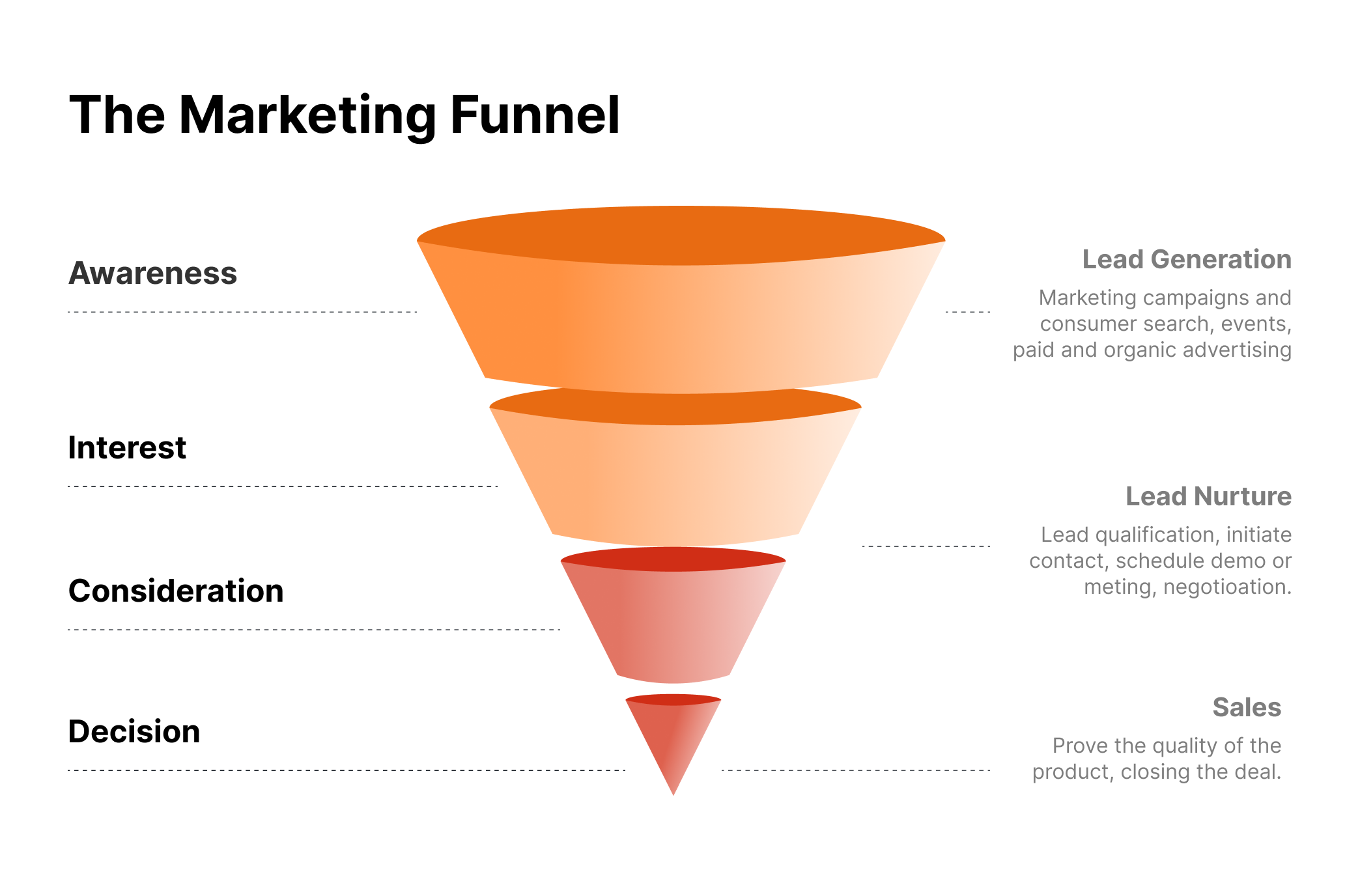
Let's quickly define the playing field. Most SaaS founders get this broadly right but miss the nuance that converts.
At the Top of the Funnel, your goal is to capture attention and build affinity. Historically, this meant writing generic "What is X?" definitions. In 2026, that strategy is dead. AI overviews answer those questions faster than you can.
Successful TOFU content now relies on thought leadership, original data reports, and contrarian takes. You aren't just defining a problem; you are framing it in a way that makes your solution inevitable later on. You want traffic, yes, but you want the right traffic.
Middle of the Funnel content is where the consideration happens. This is the bridge. Your prospect knows they have a problem (e.g., "My data is messy"), and they are evaluating categories of solutions (e.g., "Do I need a CDP or a warehouse?").
Data from First Page Sage suggests that while visitor-to-lead rates hover around 1.4% to 2.1%, the drop-off here is steep. MOFU content must validate your specific methodology. It is about proving you are the logical choice.
This is why we are here. Bottom of the Funnel content targets buyers who are product-aware. They know who you are, they know who your competitors are, and they are trying to mitigate the risk of making a bad choice.
Bofu content B2B strategy is about friction removal. It is the highest leverage work you can do. A 5-point lift in conversion here can impact revenue by upwards of 18%. This content does the heavy lifting of objection handling so your sales team doesn't have to start from scratch.
Marketing leaders often over-index on TOFU because the numbers are bigger. It feels good to report 50,000 unique visitors in a board meeting. It feels less exciting to report 500 visitors to a comparison page.
But here is the truth: those 500 visitors are holding their credit cards.
Research from Oren Greenberg shows that 90% of buyers research up to seven pieces of content before ever speaking to a sales rep. Furthermore, 70% of B2B buyers prefer to purchase or validate online without sales interaction. If your BOFU content doesn't exist - or if it is gated behind a "Talk to Sales" wall - you are losing deals to competitors who are easier to buy from.
The intent signals here are undeniable. Someone searching for "YourBrand vs CompetitorBrand" is not browsing for fun. They are looking for a reason to say yes to you, or a reason to disqualify you. If you don't control that narrative, a review site like G2 or Capterra will do it for you, and you might not like what they say.
If you need help aligning your content with these high-intent stages, you might want to look at our marketing strategy services to build a roadmap that actually converts.
Theory is fine, but execution is what pays the bills. Let's look at specific examples of BOFU content B2B assets, contrasting common mistakes with high-converting approaches.
This is the heavyweight champion of BOFU content. Your prospects are Googling this. You need to own the keyword.
The mistake: Most companies create a biased table where they have green checkmarks for every feature, and the competitor has red X's everywhere. It looks fake. It destroys trust. Sophisticated buyers know that Salesforce or HubSpot (or whoever you are fighting) isn't "bad." It's just different.
The winning approach: Use a nuanced "Who is this for?" breakdown. Admit where the competitor is strong to build credibility for your own strengths.
Example framework:
Mailchimp vs. Our Platform
Choose Mailchimp if:
Choose Us if:
By conceding a point (Mailchimp is good for solopreneurs), you validate your claim (We are best for growth teams). This builds immense trust. This honest approach to positioning in competitive B2B markets separates leaders from followers.
Your pricing page is a piece of content. Treat it like one.
The mistake: Hiding everything behind "Contact for Quote." Unless you are selling $500k+ enterprise deals, this is a massive bounce generator.
The winning approach: Give them a range or a "starting at" price. Use the CTA to promise value, not a meeting.
Notice the difference? "Contact Sales" sounds like I'm about to be hassled. "Talk to a Pricing Expert" sounds like I'm going to get help.
In B2B SaaS, buyers are often technical. They need to know how it works, not just that it works.
The mistake: Fluffy case studies that say "We increased efficiency."
The winning approach: Detailed implementation guides that show the UI.
This level of detail signals confidence and reduces implementation anxiety. These technical deep-dives mirror the specificity that makes long-tail keyword strategies for niche B2B markets so effective.
BOFU content isn't just for your website. It is ammunition for your sales team, especially when integrated with lead generation services that track buyer signals.
The mistake: Sales reps sending generic "Just checking in" emails.
The winning approach: Sending a specific asset based on a trigger.
Example:Trigger: Prospect downloads your "State of Marketing Automation" report.
Email (48 hours later):"Hi Sarah, saw you grabbed our State of Marketing Automation report. Since you are at a Series B company, I thought this might be helpful: our 'Automation Migration Checklist' for companies moving off legacy platforms. It covers the 7 things teams always forget."
This turns a cold follow-up into a value-add touchpoint.
Creating the best BOFU content B2B assets in the world won't matter if nobody sees them. You cannot rely on SEO alone for bottom-of-funnel pages because the search volume is often low (even if the intent is high). This is where comprehensive B2B SEO strategy that accounts for low-volume, high-intent keywords becomes critical.
Here is a distribution framework to ensure your best assets get in front of decision-makers.
Your first distribution channel is your own sales team. Create a "Content Map" for them. When a prospect asks about security, the rep shouldn't just say "we are secure." They should have a "Security Architecture One-Pager" ready to drop in the chat.
Turn your best success stories into PDF one-pagers. Reps should use these to handle objections in real-time. If a prospect says, "We are worried about implementation time," the rep sends a case study titled "How Company X Implemented in 14 Days."
Don't retarget homepage visitors with generic "Buy Now" ads. That is expensive and annoying. Use intent-based clustering.
This aligns the ad message with the prospect's mindset.
B2B buying happens in Slack communities, WhatsApp groups, and Reddit threads. You can't track this easily, but you can influence it.
Equip your founders and evangelists with "Zero-Click Content," summaries of your BOFU arguments that provide value directly in the feed without forcing a click. For example, a LinkedIn carousel breaking down "The Hidden Costs of Legacy CRMs" is essentially BOFU content distributed natively. This organic distribution approach works particularly well for companies focused on standing out in crowded B2B markets without big ad budgets.
How do you know if your BOFU strategy is working? You need to look at the conversion rates between lifecycle stages.
According to First Page Sage, a healthy MQL to SQL conversion rate is between 38% and 39%. If you are falling below 25%, your middle-of-funnel content isn't qualifying people hard enough, or your bottom-of-funnel content isn't convincing them to take the meeting.
Similarly, look at your SQL to Opportunity rate. This should be around 42%. If sales is accepting leads but not opening opportunities, it usually means the prospect was "educated" but not "motivated." Your content explained the product but didn't create urgency.
The era of the linear funnel is over, but the era of high-intent content is just beginning. For B2B SaaS companies, BOFU content B2B assets are not just nice-to-haves. They are the tools that allow buyers to sell your product to themselves.
With touchpoints increasing and buyers demanding self-service experiences, your ability to provide clear, honest, and specific bottom-of-funnel content is your biggest competitive advantage.
Start here:
If you are ready to build a content engine that drives revenue rather than just traffic, contact us at Apricot Studio. Our brand strategy and content strategy teams build engines for the serious players.